

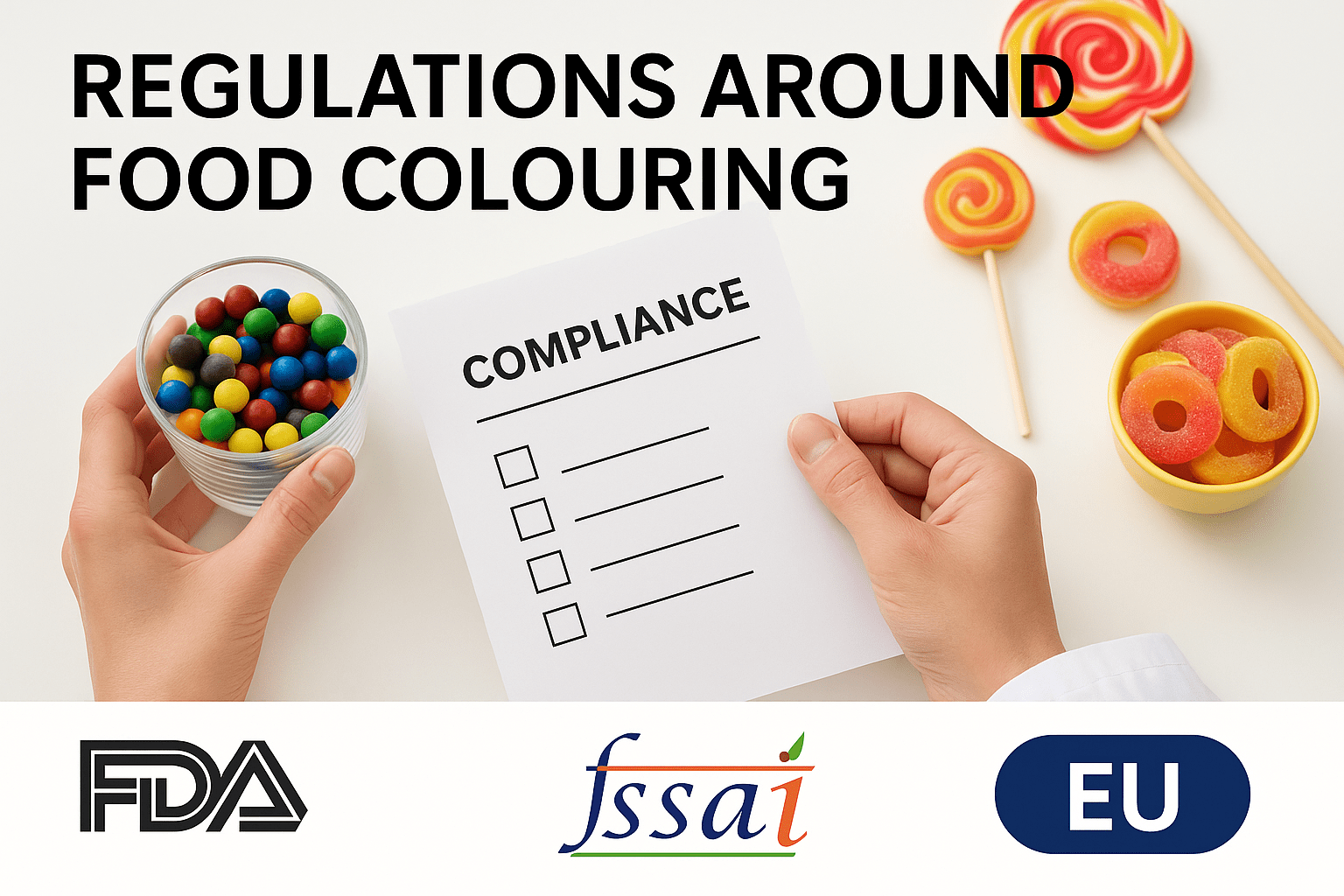
Let’s face it — colour sells. From the rich yellow of turmeric rice to the bright red swirl on a candy, colour triggers emotion and appetite. But when it comes to food colours, it’s not just about looking good. It’s also about being safe, compliant, and globally accepted.
If you’re in the business of food manufacturing, beverages, confectionery, or even nutraceuticals, the regulations around food colors are something you simply can’t afford to overlook.
So here’s a quick, no-fluff guide to help you navigate the colorful (and complex) world of food-safe dyes.
What Are Food Colors, Really?
Food colours — or food-grade dyes — are substances added to food or drink to maintain or enhance appearance. They come in two types:
Synthetic Food Colours: Lab-made, vibrant, and stable. Think Tartrazine, Allura Red, Brilliant Blue.
Natural Colors: Extracted from plants, minerals, or animals. Beetroot red, turmeric yellow, chlorophyll green.
But here’s the kicker — even if a color looks harmless, it must meet strict safety guidelines to make it to your production line.
Why Are Food Colors Regulated So Strictly?
Because food isn’t just consumed — it’s trusted. Governments and global bodies regulate liquid food colors and powders to:
- Avoid allergic reactions and toxicity.
- Ensure dyes do not degrade into harmful compounds.
- Maintain transparency and traceability in food labeling.
And let’s be honest — no brand wants to deal with a recall due to a banned colorant. Regulations protect not just health, but your brand reputation too.
Global Regulatory Overview
Let’s zoom in on how various regions handle non-toxic food colors:
1. India (FSSAI)
Only permitted synthetic colours listed in the Food Safety and Standards (Food Products Standards and Food Additives) Regulations can be used.
Labeling is mandatory — you must disclose if synthetic colors are added. Maximum permissible limits apply, often in ppm.
2. USA (FDA)
Synthetic food dyes require certification. Each batch must pass FDA testing. Only a small set of color additives are approved (like FD&C Yellow No. 5, Red No. 40). Use in drugs and cosmetics is separately governed.
3. European Union (EFSA)
Even stricter. Requires E numbers (e.g., E102 = Tartrazine). Some synthetic dyes must carry warning labels about potential hyperactivity in children. Preference toward natural alternatives is rising rapidly.
4. Middle East / GCC
Must comply with GSO standards, often aligned with Codex Alimentarius. Halal compliance is critical — alcohol-based extractions are usually not permitted.
5. ASEAN & Asia-Pacific
Vary by country. Thailand and Malaysia, for instance, allow fewer synthetic options. Demand is growing for clean-label, natural food-safe dyes.
Applications You Need to Watch
Whether you use liquid food colors or powder variants, remember that application matters:
- Beverages: Acid stability is key. Not all dyes behave well in low pH.
- Confectionery: Brightness and shelf-life matter.
- Dairy and Bakery: Heat-stable and oil-soluble options needed.
- Processed Meats: Only specific dyes are allowed — check your country’s list.
And don’t forget packaging migration rules. Your pigment might be fine in yogurt, but what about the plastic cap?
Pro Tip: Don’t Just Follow — Forecast
Many manufacturers just “follow the list.” But savvy players forecast what’s coming. Will synthetic food colours be banned in your market next year?
Are your dyes approved in export countries? Can you switch to non-toxic food colors without changing your formulation? Stay a step ahead.
How Alliance Organics Can Help
At Alliance Organics LLP, we don’t just sell dyes — we offer color solutions that check all the boxes:
- Wide range of synthetic & liquid food colors
- ROHS, FSSAI, and international compliance
- Expert guidance on region-specific regulations
- Batch-consistent, food-safe dyes trusted across 50+ countries
Plus, we ensure our formulations align with your product, process, and compliance
needs — whether you’re in India, the Middle East, or Europe.
Let’s Talk About Your Colour Needs
Want to ensure your colours are safe, legal, and long-lasting?
Contact us for a quick consultation. We’ll help you pick the right food colour — and stay regulation-ready at every step.
FAQs: Food Colors & Regulations
Q1: Are synthetic food colors safe?
Yes, when used within regulatory limits. All permitted colors are tested for toxicity, though some require warnings (e.g., Tartrazine in the EU).
Q2: Can I use one dye globally across all markets?
Not always. Regulations differ. A dye permitted in India might be banned in the EU. Always cross-check with export standards.
Q3: What’s the difference between natural and synthetic food colours? Natural colours are plant- or mineral-based; synthetic colours are chemically created. Natural options are “clean label” but may have lower stability.
Q4: Do I need to label food colour use?
Yes, in nearly every jurisdiction. Transparency is mandatory — even when using permitted synthetic food colors.
Q5: Are Alliance Organics’ dyes compliant with food safety standards? Absolutely. All our food colours are produced under ISO-certified processes and comply with FSSAI, EU, FDA, and other international standards.